By Ar Sourov | For The Embassy Journal
The political transition following the departure of Sheikh Hasina has sparked intense debate across Bangladesh regarding governance, law and order, and the country’s geopolitical balance. While opinions remain divided, a significant portion of citizens continue to question why the national situation appeared more controlled during her tenure and why many people still hope for her eventual return.
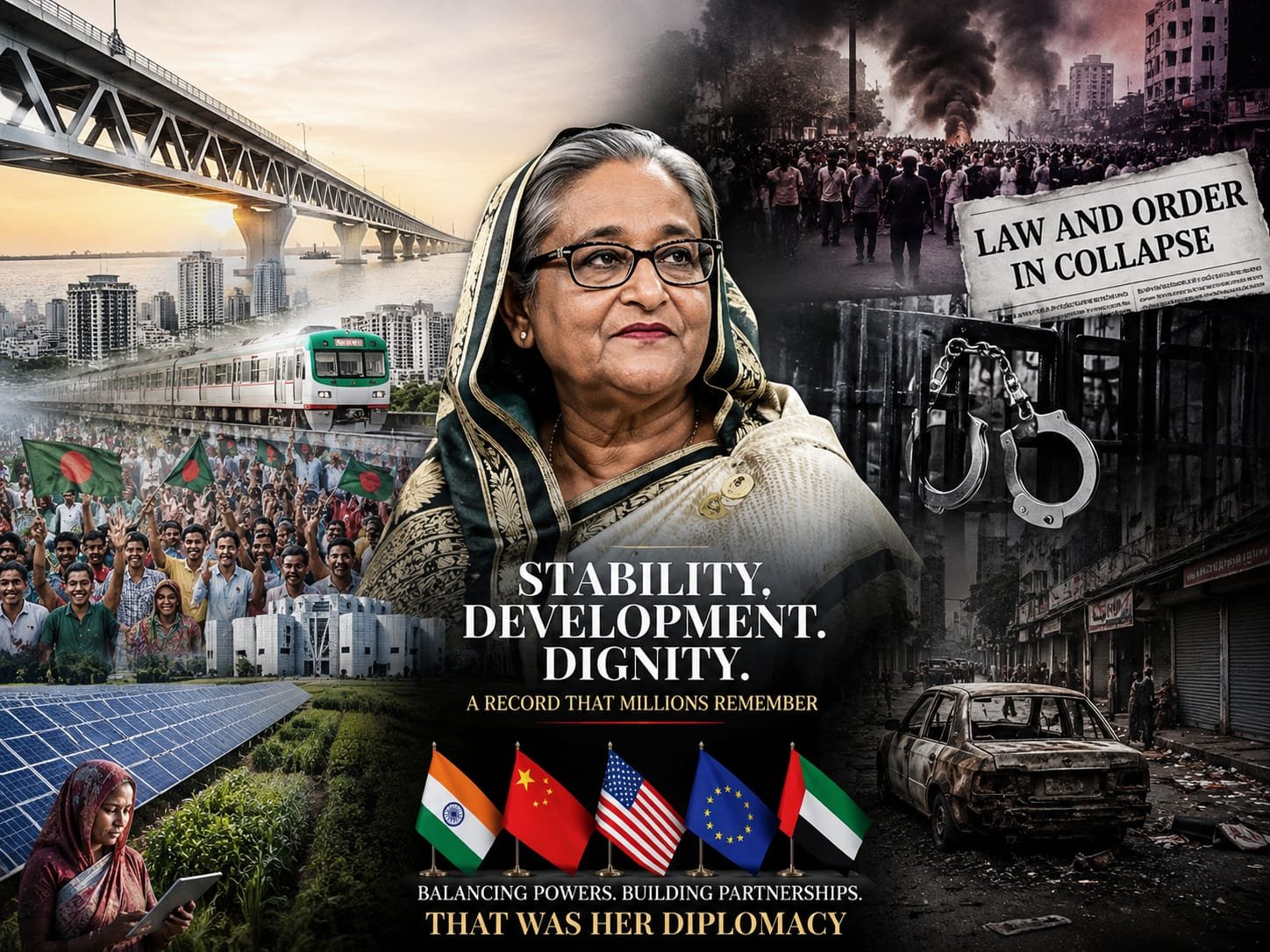
One of the most discussed issues in recent months has been the perceived deterioration of law and order. Rising concerns over street violence, political instability, organized crime, mob incidents, and insecurity in some areas have created anxiety among ordinary citizens and business communities alike. Critics of the current political environment argue that Bangladesh is experiencing a vacuum of authority, where institutions appear less coordinated and public confidence has weakened.
Supporters of Sheikh Hasina often point to her leadership style as a major factor behind the stability that Bangladesh experienced during much of her administration. Under her government, the state maintained strong centralized control over security agencies and administrative structures. Large-scale militant threats were aggressively confronted, and the government projected a firm stance against political violence and extremism.
Beyond domestic governance, many analysts acknowledge that Sheikh Hasina played a significant geopolitical balancing role in South Asia. Bangladesh, positioned between major global powers, requires careful diplomatic management. During her tenure, Dhaka maintained strategic relations with regional and international powers including India, China, the United States, and Gulf nations simultaneously. Her government was often viewed as pragmatic in foreign policy — cooperating economically with China, maintaining security and regional coordination with India, while also engaging Western governments on trade, counterterrorism, and development.
This diplomatic balancing act allowed Bangladesh to secure infrastructure investment, export growth, energy cooperation, and international strategic relevance without openly aligning too heavily with one bloc. Supporters believe this experience and continuity are difficult to replace during periods of political uncertainty.
For many Bangladeshis, the discussion surrounding Sheikh Hasina is not only about politics, but also about economic memory. Her years in office coincided with massive infrastructure expansion, rapid GDP growth, increased electricity coverage, digitalization, and internationally recognized development projects such as the Padma Bridge and metro rail initiatives.
As political uncertainty grows, many citizens increasingly associate her leadership with stability, administrative discipline, and long-term development planning. This is one reason why conversations surrounding her possible return continue to dominate social and political discussions across the country.
Whether viewed through politics, diplomacy, or national development, Sheikh Hasina remains one of the most influential and consequential figures in modern Bangladeshi history. And for many of her supporters, the expectation of her return is no longer just political speculation — it has become a symbol of restoring order, continuity, and confidence in the direction of the nation.