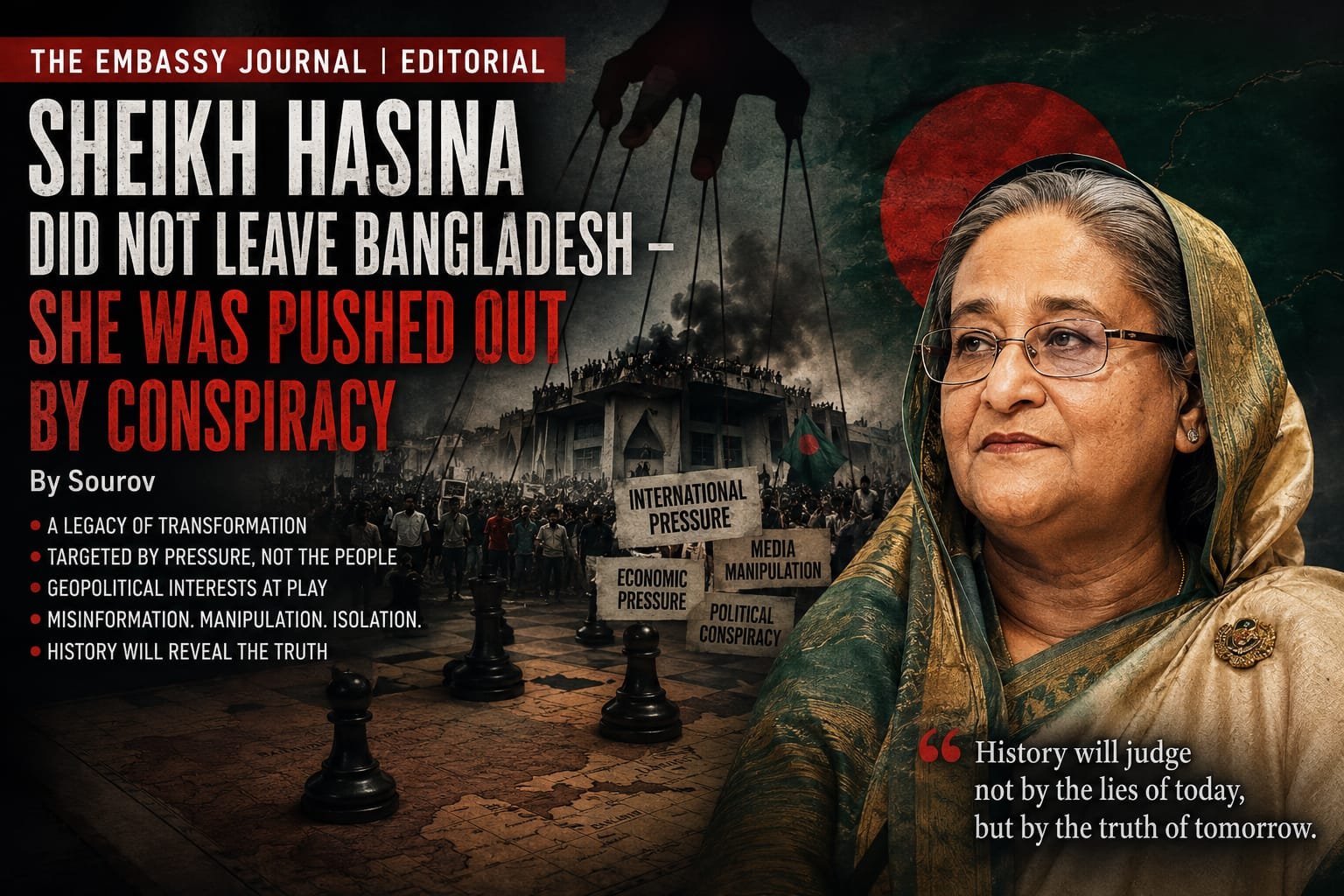
By Sourov | Editorial | The Embassy Journal
History often remembers not only the leaders who ruled nations, but also the forces that worked silently to remove them. The political departure of from Bangladesh cannot be understood through simplistic headlines or emotional propaganda. To say she “fled” the country ignores the deeper geopolitical, economic, and ideological tensions that had been building for years. Leaders with strong regional influence are rarely removed by coincidence — they become targets of coordinated pressure.
Under Sheikh Hasina’s leadership, Bangladesh transformed itself from a struggling developing nation into one of South Asia’s fastest-growing economies. Massive infrastructure projects, digital expansion, women’s empowerment, improved electricity access, and the rise of Bangladesh’s global garment industry changed the country’s image before the world. From the Padma Bridge to metro rail connectivity, her administration pursued ambitious development policies that many believed impossible a decade ago.
But rapid national growth also creates powerful enemies.
Bangladesh’s increasing strategic importance in the Bay of Bengal, its growing partnerships with regional powers, and its economic independence made the country a center of international interest. In modern politics, influence is no longer exercised only through military intervention; it is shaped through media narratives, diplomatic pressure, economic manipulation, and internal polarization. When a leader becomes too independent, too influential, or too difficult to control, opposition does not come only from within the borders.
This is why many observers believe Sheikh Hasina was not simply “defeated” politically — she was isolated through a sophisticated combination of domestic unrest, international pressure, misinformation campaigns, and elite political calculations. The objective was not merely to remove a Prime Minister, but to weaken a political legacy that had dominated Bangladesh for more than a decade.
Yet history has a strange habit: leaders who leave under pressure often return stronger in public memory. Time separates propaganda from reality. Today, regardless of political opinion, even critics acknowledge that Bangladesh experienced undeniable structural transformation during her tenure. Roads, bridges, economic corridors, and digital governance remain visible evidence of that era.
Nations eventually judge leaders not only by controversy, but by contribution.
And perhaps the most important question Bangladesh must ask itself is this: Was Sheikh Hasina truly abandoned by the people — or was she strategically pushed aside by forces far more powerful than ordinary politics?
The answer may define the next chapter of Bangladesh itself.