Close Menu
The Embassy Journal
  • Home
  • Diplomatic Insights
  • Cultural Diplomacy
  • Opinion Section
  • Travel & Heritage
  • Business
  • Regional Highlights
  • More
    • International Business
    • Global Affairs Analysis
    • Embassy News and Events
    • Diplomatic Affairs and Relations
    • Thematic Sections for Each Embassy
    • Sustainability & International Cooperation
    • Cultural Exchange and Global Outreach
What's Hot

Sheikh Hasina Did Not Leave Bangladesh — She Was Pushed Out by Conspiracy

May 21, 2026

“NOTHING COULD STOP ME” — Sheikh Hasina Signals Dramatic Return to Bangladesh

May 19, 2026

Protecting Journalists and Ensuring Media Freedom Must Be a National Commitment

May 19, 2026
Facebook X (Twitter) Instagram
4:26 AM -5 June 2026
Facebook X (Twitter) Instagram
All Section
The Embassy Journal
Button Login
  • Home
  • Diplomatic Insights
  • Cultural Diplomacy
  • Opinion Section
  • Travel & Heritage
  • Business
  • Regional Highlights
  • More
    • International Business
    • Global Affairs Analysis
    • Embassy News and Events
    • Diplomatic Affairs and Relations
    • Thematic Sections for Each Embassy
    • Sustainability & International Cooperation
    • Cultural Exchange and Global Outreach
The Embassy Journal
  • Home
  • Business
  • Cultural Diplomacy
  • Cultural Exchange and Global Outreach
  • Diplomatic Affairs and Relations
  • Diplomatic Insights
  • Embassy News and Events
  • Global Affairs Analysis
  • International Business
  • Opinion Section
  • Regional Highlights
  • Sustainability & International Cooperation
  • Thematic Sections for Each Embassy
  • Travel & Heritage
Home»Popular Post»The Iron Lady vs. The White House: How Sheikh Hasina Outplayed Washington for Ruppur
Popular Post

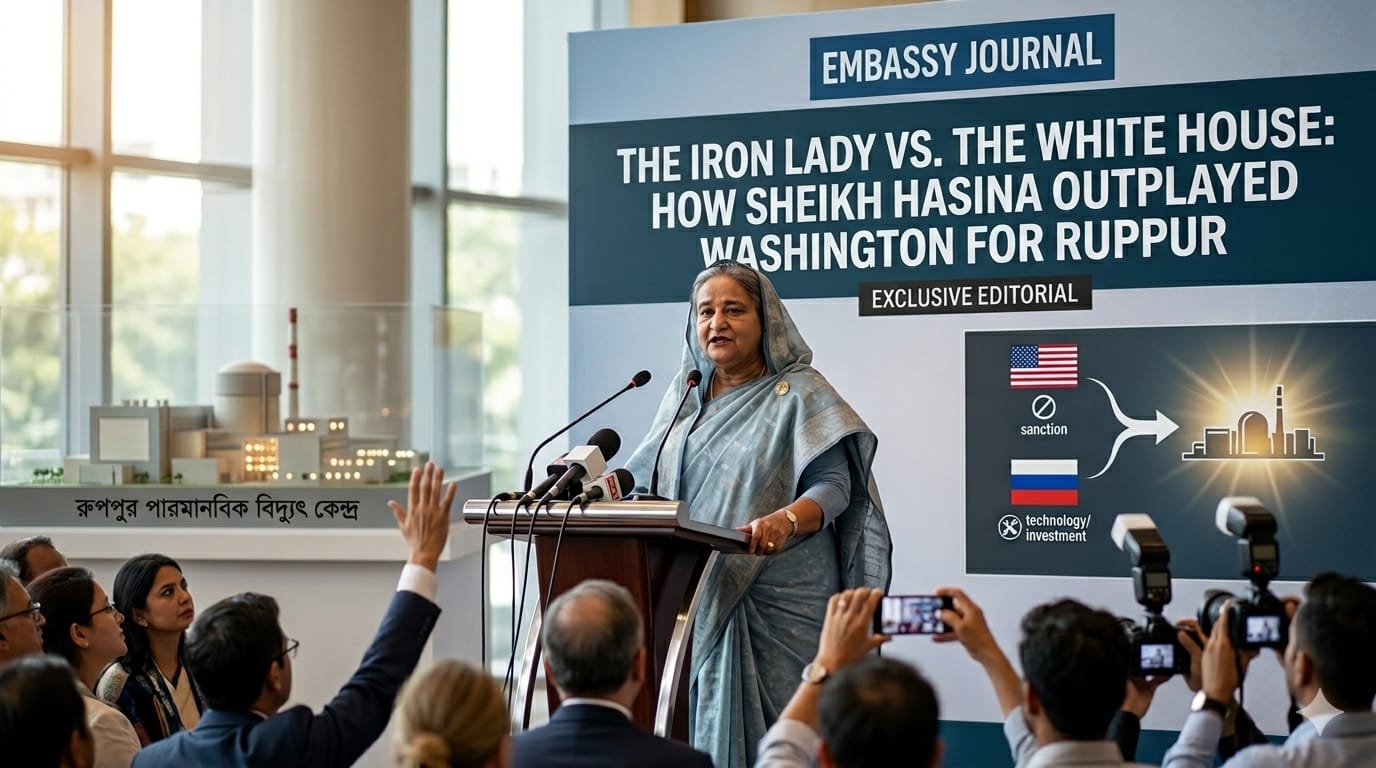
The Iron Lady vs. The White House: How Sheikh Hasina Outplayed Washington for Ruppur

The Embassy JournalBy The Embassy JournalMay 17, 2026No Comments4 Mins Read
Facebook Twitter Pinterest LinkedIn Tumblr Email
Share
Facebook Twitter LinkedIn Pinterest Email

Editorial | Embassy Journal

By Sourov
May 17, 2026

In the theater of modern geopolitics, small and developing nations are frequently forced into the uncomfortable position of choosing sides between global superpowers. However, the trajectory of Bangladesh’s first nuclear venture — the Ruppur Nuclear Power Plant (RNPP) — offers a compelling case study in strategic autonomy. It demonstrated how former Prime Minister Sheikh Hasina aggressively pursued her nation’s developmental imperatives while resisting external geopolitical pressures, earning her a reputation in regional diplomatic circles as an uncompromisingly pragmatic leader driven by national interest.

The Genesis of a Nuclear Dream

The foundational blueprint for the Rooppur Nuclear Power Plant was revitalized shortly after Sheikh Hasina assumed office in 2009. Driven by her vision to transform Bangladesh into a technologically advanced nation, the formal framework took shape through a series of bilateral agreements with Russia.

2011: Sheikh Hasina signed a crucial inter-governmental agreement with Russia for the implementation of the project.

2015: The generalized contract was finalized, appointing Rosatom as the builder and technology provider.

2016: Financial arrangements were completed, with Russia agreeing to finance nearly 90 percent of the project through a state-backed credit facility.

Construction officially began in November 2017 with the first concrete pouring for Unit-1. For Sheikh Hasina, Ruppur was not merely a power plant — it was a mega-project symbolizing Bangladesh’s entry into the elite global nuclear community.

The Geopolitical Shockwave

The true test of Hasina’s diplomatic resilience emerged in 2022 following the outbreak of the Russia-Ukraine War. The United States and its Western allies imposed sweeping sanctions on Moscow, targeting Russian banks, financial institutions, shipping networks, and strategic entities.

Bangladesh suddenly found itself caught in a geopolitical crossfire. The pressure from Washington and its allies intensified, particularly concerning transactions and logistics connected to Russian-backed projects. For Bangladesh — a country deeply dependent on Western export markets, especially in the ready-made garments sector — openly resisting such pressure carried enormous economic and diplomatic risks.

How Hasina Managed the Crisis

Rather than suspending the project, Sheikh Hasina’s administration adopted a layered diplomatic and financial strategy that allowed the Ruppur project to continue despite global restrictions.

Currency Diversification and Financial Strategy

With several Russian banks disconnected from the SWIFT payment network, conventional US dollar transactions became increasingly difficult. Dhaka and Moscow explored alternative payment mechanisms, including discussions involving the Chinese Yuan through intermediary financial systems, reducing reliance on the US-dominated financial structure.

The Maritime and Logistics Challenge

In late 2022, sanctions-related complications emerged surrounding Russian shipping vessels carrying equipment for the Ruppur project. Bangladesh carefully navigated the diplomatic sensitivity by adjusting logistical routes and shipment procedures without halting construction activities.

Framing the Issue as National Interest

Throughout the crisis, Sheikh Hasina’s administration consistently framed the Ruppur project as an energy-security necessity for Bangladesh rather than a geopolitical alignment. Her government maintained the long-standing foreign policy principle of “Friendship to all, malice to none,” emphasizing that Bangladesh’s developmental priorities would not be dictated by global rivalries.

The Strategic Outcome

The delivery of Russian nuclear fuel to the Ruppur site in 2023 became one of the most symbolic moments of the project. It demonstrated Bangladesh’s determination to continue its long-term energy ambitions despite immense geopolitical pressure.

Supporters of Sheikh Hasina argue that her handling of the Ruppur issue reflected a rare form of strategic balancing rarely seen among leaders of developing nations. By simultaneously maintaining ties with Russia, China, India, Western powers, and regional partners, she projected Bangladesh as a country capable of defending its national interests without fully surrendering to any geopolitical bloc.

While debates over her domestic politics continue, the Ruppur episode remains one of the strongest examples cited by her supporters to highlight her diplomatic resilience and geopolitical maneuvering. To many observers, it cemented Sheikh Hasina’s image as a leader willing to withstand pressure from global powers in pursuit of Bangladesh’s long-term national ambitions.


Share this:

  • Share on Facebook (Opens in new window) Facebook
  • Share on X (Opens in new window) X

Like this:

Like Loading…
Share. Facebook Twitter Pinterest LinkedIn Tumblr Email
The Embassy Journal
  • Website

Related Posts

Awami League Leader AFM Bahauddin Nasim Calls for Unity and Resilience Amid Political Crisis

May 14, 2026

🇨🇦 Canada Expands Diplomatic Operations in Dhaka Amid Growing Bangladesh–Canada Relations

May 14, 2026

Washington Summit: A Fragile Peace on a Razor’s Edge

May 14, 2026
Leave A Reply Cancel Reply

Economy News
Diplomatic Affairs and Relations

Sheikh Hasina Did Not Leave Bangladesh — She Was Pushed Out by Conspiracy

By The Embassy JournalMay 21, 20260

By Sourov | Editorial | The Embassy Journal History often remembers not only the leaders…

Share this:

  • Share on Facebook (Opens in new window) Facebook
  • Share on X (Opens in new window) X

Like this:

Like Loading…

“NOTHING COULD STOP ME” — Sheikh Hasina Signals Dramatic Return to Bangladesh

May 19, 2026

Protecting Journalists and Ensuring Media Freedom Must Be a National Commitment

May 19, 2026
Top Trending
Diplomatic Affairs and Relations

Sheikh Hasina Did Not Leave Bangladesh — She Was Pushed Out by Conspiracy

By The Embassy JournalMay 21, 20260

By Sourov | Editorial | The Embassy Journal History often remembers not…

Share this:

  • Share on Facebook (Opens in new window) Facebook
  • Share on X (Opens in new window) X

Like this:

Like Loading…
Diplomatic Affairs and Relations

“NOTHING COULD STOP ME” — Sheikh Hasina Signals Dramatic Return to Bangladesh

By The Embassy JournalMay 19, 20260

Former Prime Minister Declares Survival Through 19 Assassination Attempts as Proof of…

Share this:

  • Share on Facebook (Opens in new window) Facebook
  • Share on X (Opens in new window) X

Like this:

Like Loading…
Cultural Diplomacy

Protecting Journalists and Ensuring Media Freedom Must Be a National Commitment

By The Embassy JournalMay 19, 20260

By Sourov DHAKA: Marking World Press Freedom Day 2026, the Diplomatic Network…

Share this:

  • Share on Facebook (Opens in new window) Facebook
  • Share on X (Opens in new window) X

Like this:

Like Loading…

Subscribe to News

Get the latest sports news from NewsSite about world, sports and politics.

Advertisement
Demo
Facebook X (Twitter) WhatsApp TikTok Instagram YouTube

News

  • World
  • US Politics
  • EU Politics
  • Business
  • Opinions
  • Connections
  • Science

Company

  • Information
  • Advertising
  • Classified Ads
  • Contact Info
  • Do Not Sell Data
  • GDPR Policy
  • Media Kits

Services

  • Subscriptions
  • Customer Support
  • Bulk Packages
  • Newsletters
  • Sponsored News
  • Work With Us

Subscribe to Updates

Get the latest creative news from FooBar about art, design and business.

© 2026 The Embassy Journal. Designed by Insoftbook.
  • Privacy Policy
  • Terms
  • Accessibility

Type above and press Enter to search. Press Esc to cancel.

Sign In or Register

Welcome Back!

Login below or Register Now.

Prove your humanity


Lost password?

Register Now!

Already registered? Login.

A password will be e-mailed to you.

%d