By Sourov | Special Correspondent
Published: May 12, 2026
HOW SHEIKH HASINA BUILT BANGLADESH’S STRONG VACCINE SYSTEM: A STORY OF GREAT LEADERSHIP
A clear look at how Sheikh Hasina changed Bangladesh from a country with weak healthcare into a world leader in saving children’s lives.
DHAKA — In the world of international development, a country’s healthcare system is a key part of its strength. Between 2009 and 2024, Bangladesh showed the world how to protect its people.
Under the direct leadership of *Sheikh Hasina, the country changed completely. It went from being a nation that struggled with basic healthcare to a global leader in vaccination. For a diplomatic observer, this success was not an accident. It happened because *Sheikh Hasina made bold decisions, used smart planning, and worked closely with global partners.
Here is the step-by-step history and the official facts showing how Sheikh Hasina built this protective shield for her nation, as verified by the WHO, UNICEF, and Gavi, The Vaccine Alliance.

THE YEAR-BY-YEAR TIMELINE OF SUCCESS (2009–2024)
The growth of Bangladesh’s immunization program under Sheikh Hasina happened in clear stages, starting with basic childhood shots and moving to advanced medical science.
Phase 1: Building the Foundation (2009–2013)
- 2009 — The Pentavalent Vaccine: In her very first year in office, the government made it easier for babies to get protection. They launched the Pentavalent vaccine, which protects against five deadly diseases (Diphtheria, Tetanus, Pertussis, Hepatitis B, and Hib) in just one shot. It became available across the country by July 2009.
- 2010 — The UN MDG-4 Award: The government ran a massive campaign that vaccinated 18.1 million children against Measles. Because of this major effort to lower child mortality, Bangladesh achieved its UN Millennium Development Goal early and received a global award.
- 2011 — The Digital Health Award: At the United Nations, Sheikh Hasina received an award for using technology to improve health. She used digital systems to track vaccinations through a new network of rural community clinics.
- 2012 — Preventing Birth Defects: The government introduced the combined Measles-Rubella (MR) vaccine along with a necessary second dose. This helped protect unborn babies from dangerous birth defects.
Phase 2: Eradicating Diseases (2014–2019)
- 2014 — The 53.6 Million Miracle & Polio-Free Status: Sheikh Hasina’s administration ran one of the biggest vaccine drives in world history. They vaccinated 53.6 million children against Measles and Rubella in less than three weeks. In March of that year, the WHO officially declared Bangladesh completely Polio-Free.
- 2015 — Fighting Pneumonia: The government introduced the PCV-10 vaccine for free to fight pneumonia, which was the biggest killer of young children in the country.
- 2016–2017 — Modern Medical Standards: Bangladesh became one of the first developing nations to use fractional-dose IPV (fIPV), a smarter and more efficient way to give polio shots. In 2016, a highly successful pilot program for the HPV vaccine (against cervical cancer) was launched in Gazipur, reaching over 85% of young girls.
- 2018 — Rubella Controlled: The WHO officially confirmed that Bangladesh had successfully controlled and stopped the spread of Rubella.
THE GLOBAL RECOGNITION: THE “VACCINE HERO” AWARD (2019)
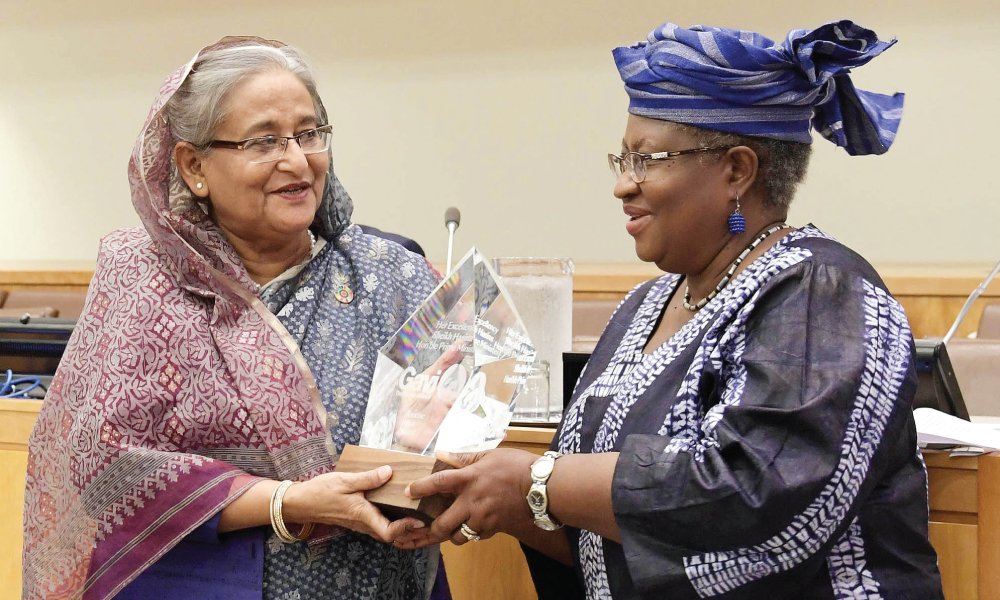
On *September 23, 2019, at the United Nations Headquarters in New York, Gavi, The Vaccine Alliance, gave its highest honor, the **Vaccine Hero Award, to Prime Minister *Sheikh Hasina. This award recognized her personal commitment to health.
“Sheikh Hasina is a true champion of immunisation… From her hands-on approach at home—personally launching every major immunisation campaign—to her consistent championing of immunisation on the global stage, Prime Minister Hasina is unequivocally a vaccine hero.”
— Dr. Seth Berkley, Former CEO of Gavi, The Vaccine AlliancePhase 3: Pandemic Success & Future Protection (2020–2024)
- 2020–2022 — Excellent COVID-19 Management: During the global pandemic, Sheikh Hasina’s quick diplomacy secured early vaccine doses from the Serum Institute of India, the US, and China. Using her pre-existing rural health network, the government gave out more than 130 million doses in 2021 alone, keeping the economy open and protecting over 88% of the target population.
- 2023 — The National HPV Drive: The government launched a nationwide campaign to give the HPV vaccine completely free of cost to more than 10 million schoolgirls to eliminate cervical cancer for future generations.
- 2024 — The Highest Peak: By the middle of 2024, official WHO and UNICEF data showed that Bangladesh reached its highest vaccination rate in history, with 97% of children receiving their first Measles-Rubella shot.
THE RECORD IN NUMBERS
The economic and health results achieved under Sheikh Hasina serve as an example for the entire world:
The Metric The Achievement Under Sheikh Hasina Verifying Organization Routine Vaccine Coverage 97% of children fully reached WHO / UNICEF Economic Return $25 saved for every $1 spent on vaccines Global Health Economists Child Mortality Rate Dropped to an all-time low of 31 deaths per 1,000 United Nations (IGME) Lives Saved Annually 94,000 child deaths prevented every year National Health Surveys THE CONCLUSION
The data shows a very clear picture. Sheikh Hasina did not just treat vaccination as a basic medical program; she made it a national priority. By building more than 14,000 rural community clinics and using digital tracking, her leadership created a strong health shield for the country.
Millions of children in Bangladesh are alive, healthy, and growing up well today because of the system built under her administration. In the history of global health, Sheikh Hasina’s work stands as a true success story.