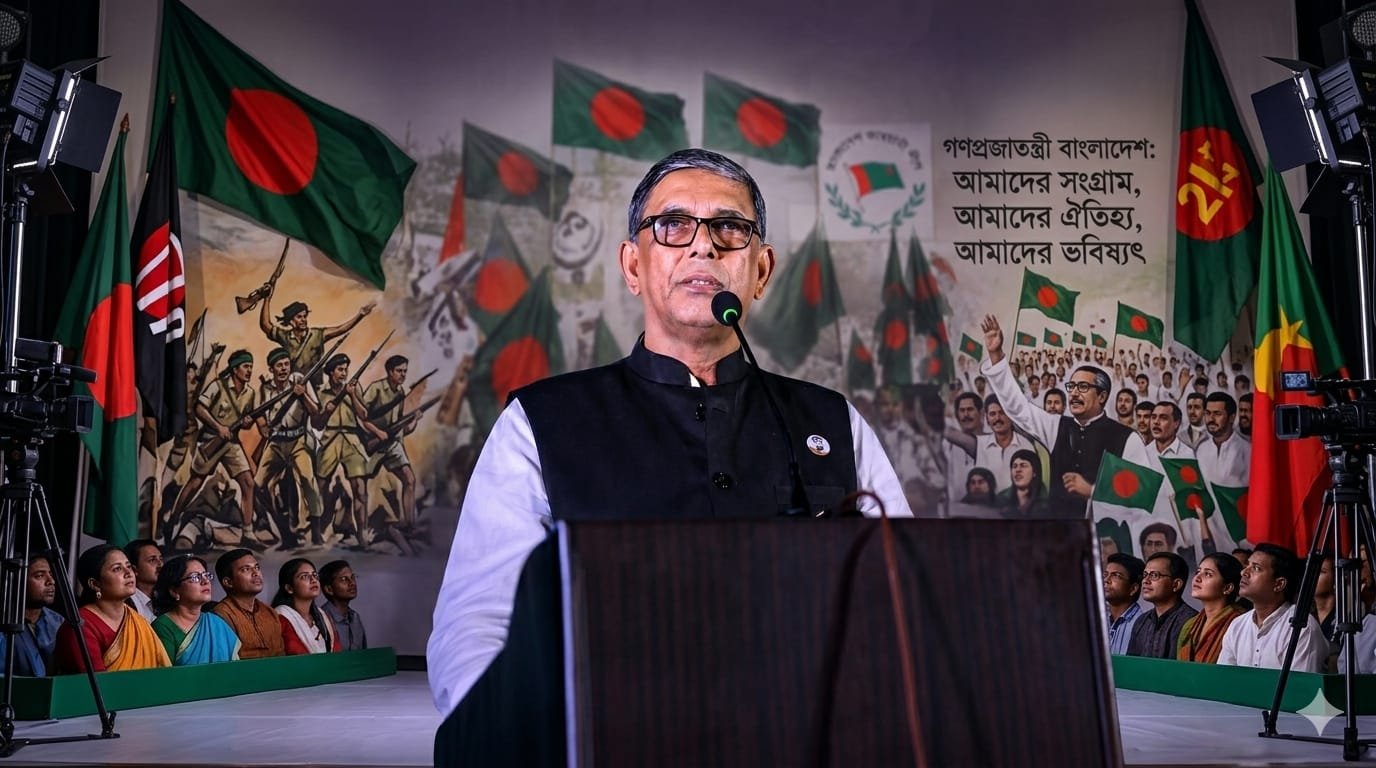
Dhaka, Bangladesh — In a powerful and emotionally charged statement during a tense period in Bangladesh’s political landscape, Bangladesh Awami League Joint General Secretary AFM Bahauddin Nasim declared that no storm, no matter how fierce, would be able to break the spirit of the party or its supporters. His remarks, delivered before party activists and supporters, quickly gained attention across political circles and social media platforms for their strong tone of resilience and determination.
“No matter how big the storm, the anchor will not break — we are here, the fight will continue. The crisis is our biggest test. Victory is guaranteed if you pass this test,” Nasim said while addressing party workers at a gathering in Dhaka.
The speech came at a time when Bangladesh is experiencing heightened political tension, economic uncertainty, and growing debates over governance, democratic processes, and the future direction of the country. Nasim’s remarks appeared aimed at energizing party supporters while also sending a message to political opponents that the ruling party remains confident and united despite challenges.
Political analysts say the metaphor of the “anchor” used by Nasim carries deep symbolic meaning. In times of storms, anchors are traditionally associated with stability, resistance, and survival. By comparing the Awami League to an unbreakable anchor, Nasim sought to project the image of a party that remains firmly rooted despite waves of political pressure.
During his speech, Nasim emphasized that political crises should not be viewed merely as obstacles but as opportunities to prove strength, discipline, and loyalty. According to him, history has repeatedly shown that the Awami League has survived difficult moments through sacrifice and unity.
“The Awami League was not built overnight. This party was created through struggle, sacrifice, and the blood of countless leaders and activists. Whenever the nation faced uncertainty, the Awami League stood beside the people,” he reportedly told the audience.
Supporters attending the event responded with loud applause and slogans expressing solidarity with the party leadership. Many activists described the speech as motivational, particularly at a moment when party members are facing criticism and increasing political polarization.
Observers note that the ruling Awami League has often used narratives of resilience and historical struggle as part of its political identity. Founded in 1949, the party played a leading role in Bangladesh’s independence movement and has long portrayed itself as a guardian of the country’s liberation values. Speeches like Nasim’s are seen as efforts to reinforce that image among supporters.
At the same time, opposition groups have criticized the ruling party’s rhetoric, arguing that political challenges should be addressed through dialogue, transparency, and democratic reforms rather than confrontational political messaging. Critics claim that the current political environment requires compromise and national unity instead of intensifying partisan narratives.
Despite criticism, Awami League leaders maintain that the party remains committed to stability and development. In recent years, government officials have highlighted achievements in infrastructure, economic growth, digital transformation, and social development as evidence of the party’s success in governance.
Nasim’s comments also reflected a broader message of endurance under pressure. By calling the crisis “the biggest test,” he framed the current situation as a defining moment not only for the party but also for its supporters. The idea that “victory is guaranteed” if supporters successfully endure hardship appeared intended to inspire confidence and perseverance.
Political communication experts suggest that speeches delivered during times of crisis often serve two major purposes: strengthening internal morale and shaping public perception. Nasim’s remarks accomplished both by combining emotional symbolism with a call for collective endurance.
The speech has since circulated widely online, with supporters sharing clips and quotations across Facebook and other social media platforms. Some users praised the statement as a reminder of political courage, while others debated its implications within Bangladesh’s broader political context.
Bangladesh’s political environment has remained highly competitive in recent years, with tensions between major political parties frequently leading to protests, accusations, and public demonstrations. Against this backdrop, speeches from senior political leaders often attract significant public attention and media coverage.
For many Awami League supporters, Nasim’s words represented a message of hope during uncertainty. Party activists described the statement as an encouragement to remain patient and loyal despite challenges. Several youth leaders attending the gathering said the speech reinforced their belief that political struggles are temporary and that determination ultimately leads to success.
Meanwhile, neutral observers say the speech highlights how deeply emotional narratives continue to shape South Asian politics. Appeals to sacrifice, resistance, and collective struggle remain powerful tools for mobilizing supporters and maintaining party identity.
As Bangladesh moves through another politically sensitive period, speeches like Nasim’s are expected to continue influencing public discussions and party dynamics. Whether viewed as a motivational call for resilience or as a strategic political message, the statement has clearly resonated with supporters and reignited conversations around leadership, crisis, and political endurance.
In the end, Nasim’s central message remained clear: challenges may grow stronger, storms may intensify, but according to him, the foundation of the party and its movement remains unshaken. For supporters gathered before him, the speech was not only about politics — it was about survival, loyalty, and the belief that perseverance eventually leads to victory.